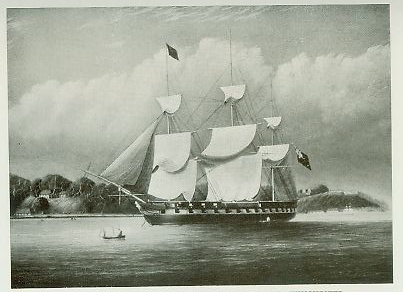
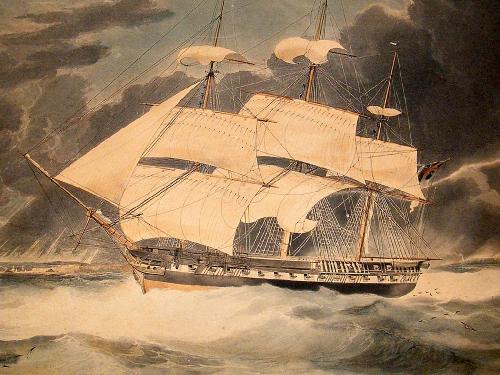
| 1816 |
Laid
down in Woolwich on the River Thames, London as a Java (Southampton) Class fourth
rate 60 gun frigate 16 42 pound guns, 8 carronades and 36 24 pound
guns. 1,487 tbm; 173' x 44' 6". She weighed 487 tons and had a full
compliment of 450 men and boys. Her lines were sharp, approaching those
of a clipper, yet she could carry tons of foodstuffs, fresh water, and
war material to keep her at sea for months. She was well sparred and
crossed three skysail yards. And she wad described as a perfect gem in
hull and rigging, not at all like most short, wide and shallow British
warships of the fourth rate. She had what is called a "Circular Stern" see sketch.
Other ships in the class, in build order, were Southampton, Portland, Lancaster, Winchester, Chichester and Worcester
|
| 1822 Jun 21 |
Launched. |
1822 Sep 16
|
Commissioned
|
1828
|
Commanded by Capt Charles J Austen, brother of author Jane Austen. The diary
and private journal of Charles John Austen (latterly Rear Admiral) for
1830 is held by the National Maritime Museum: The Caird Library,
Manuscripts Section Record Reference AUS/131-132. NRA catalogue
reference. NRA 30121.
|
Flagship North America & West Indies under Edward Griffith Colpoys,
until invalided. In October 1828 the ship visited Jamaica.
|
1829 Oct 9
|
Under repair in dock at Chatham and fitting for foreign service.
|
1830 Jan 27
|
Arrived Portsmouth from Chatham to prepare for service on the Jamaica and Halifax station.
|
1830 to 1839
|
Still commanded by Capt Charles J Austen.
|
| 1830 Feb 14
|
Departed Portsmouth for the West Indies.
|
| 1830 Jul
|
Jamaica Station.
|
| 1831 |
Capt.
was Lord William Paget, In May she was in the West Indies. |
1831 Jan 10
|
Arrived Antigua from Bermuda.
|
1831 Jan 31
|
Winchester, Champion, and Hyacinth, arrived at Barbadoes from Martinique.
|
1831 Feb
|
A
court-martial had been held on board the Shannon, Capt. B. Clement, by
order of Vice-Admiral Colpoys, to try Commander Charles H. Williams, of
his Majesty's ship Racehorse, 18, on charges preferred against him by
supernumerary Commander William Oldrey, who was ordered a passage in
the Racehorse, to join the Winchester, at Jamaica, for conduct towards
Commander Oldrey, having a tendency to bring him into disrespect as an
officer of his Majesty's navy. Several of the officers of the Racehorse
were examined by the court, which, after sitting four days, adjudged
Commander Williams to be fully acquitted.
|
1831 Apr 5
|
Departed Jamaica for Montego Bay.
|
1831 Jun 15
|
Arrived Portsmouth from Jamaica and Bermuda, Capt. the Right Hon. Lord William Paget in command.
|
1831 Jun 23
|
In Portsmouth Harbour.
|
| 1831 Jun 29 |
An
order has been issued to assemble a Court Martial, on board the
Caledonia, at Spithead, to try Capt. the Right Hon. Lord William Paget,
for having ordered Capt. Ayscough, late Commissioner at Bermuda, to be
ex-cluded from the cabin allotted to him on board His Majesty's ship
Winchester, by Vice-Admiral Colpoys, Commander-in-
Chief on the Bermuda Station, and for disrespectful and unofficer-like
behaviour, during the passage to England, in that ship. The C.M. was
held on 29 Jun., but no evidence being produced by Capt. Ayscough, and
the case not being proved, Capt. Paget's sword was returned along with
the usual address.
|
1831 Jul 23
|
In Portsmouth Harbour.
|
1831 Sep 4
|
Departed
Portsmouth with Barham and Victor to cruise in the Channel, to try
their respective rates of sailing, under the orders of Rear-Admiral
Parker, who shifted his flag on the occasion to the Barham.
|
1831 Sep 7
|
Anchored at St. Helen's. |
1831 Sep 9
|
Departed Portsmouth for Halifax.
|
1831 Oct 26
|
Departed Halifax for Bermuda.
|
1831 Dec 22
|
Departed Bermuda for Barbadoes.
|
1832 Jan 5
|
Arrived
Barbadoes, and joined the Pallas and Ranger at anchor. The
officers donated one pound each, and the men two days pay towards
the fund created to assist the sufferers and repair the damage caused
by the the recent hurricane here. Earlier reports of severe damage were
stated not to have been exaggerated.
|
1832 Jan 15
|
Due to depart Barbadoes for Jamaica.
|
1832 Jan 30
|
Arrived Jamaica from Aux Cayes.
|
1832 Apr 2
|
Departed Bermuda for Barbados.
|
1832 May 10
|
At
Port Royal, Jamaica, when the Champion departed for England. Was also
shortly due to depart Port Royal for Havannah, Bermuda and ultimately
Halifax.
|
1832 May 18
|
Due to depart Port Royal for Havannah.
|
1832 Jun 3
|
Arrived Bermuda.
|
1832 Aug 10
|
When the Conway
departed Port Royal, Jamaica, it was reported that the Winchester,
Columbine and Pallas were supposed to be at Bermuda, however the
Blossom seemed to think things were a bit different......see the next
report....
|
1832 Aug 12
|
When
the Blossom departed Halifax she left the Winchester, Columbine, and
schooner Monkey at Halifax ; the former due to sail to St. John's,
N.B., with the 34th Regt., in a few days, which since she'd seen them
makes her report more likely, plus tradition dictated the flag ship
usually spent the summer at Halifax, and then, following the first real
frost, would depart south for the West Indies leaving one of the
squadron at Halifax.
|
1832 Sep 7
|
At Halifax, flying the flag of Admiral Colpys, with the Racehorse.
|
1832 Sep 15
|
At
Halifax, Flag, with the Sapphire, Racehorse, and Monkey, where the
Ariadne and Victor were supposedly expected, when the transport Orestes
departed for Portsmouth, England.
|
1832 Oct 4
|
At Halifax, with the Sapphire and Victor.
|
1832 Oct 21
|
Left Halifax for Bermuda, flag ship.
|
1832 Nov 3
|
Left Bermuda for Jamaica with troops.
|
1833 Jan 8
|
At Jamaica.
|
1833 Apr 21
|
Left Jamaica for England.
|
1833 May 24
|
Arrived Spithead from Jamaica, having been in collision with Greilma, from New York, to Antwerp.
|
1833 May 26
|
Left Spithead for Chatham.
|
1833 Jun 12
|
Paid off at Chatham, assume for repairs following collission with Greilma.
|
| 1834-38 | Seven
logbooks for these years are held by the US Library of Congress,
Manuscript Division Reference : GB, Navy, Cont 183-189 http://www2.hmc.gov.uk/nra/searches/locresult.asp?LR=734 |
| 1834 | Capt.
Edward Sparshott appointed.
|
1834 Oct 8
|
Arrived Portsmouth from Chatham, for service in the East Indies.
|
| 1834 Oct 18 |
Preparing at Portsmouth for a passage to the Cape and Bombay. |
1834 Oct 25
|
Departed Portsmouth for Madeira, the Cape of Good Hope, and East Indies. |
1834 Nov 25
|
Spoke with the Doncaster lat. 7 N, long. 20 ; the Winchester is bound for Bombay. |
1834 Dec
|
Reportedly at Bombay. |
1835 Mar 14
|
In Bombay roads with the Melville.
|
| 1835 Mar 17 |
Remained at Bombay when the Melville departed for England.
|
1835 Dec 8
|
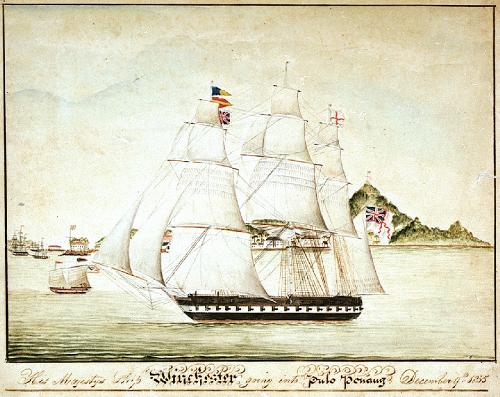
Entered Pulo Penang
|
1836 Aug 4
|
Reported to be at Trincomalee.
|
1836 Oct 11
|
Arrived Madras from Trincomalee.
|
| 1837 | Flagship
of Rear Ad. Sir Frederick Maitland, East Indies.
|
1837 Jun23
|
Departed Madras for Negapatam and Bengal.
|
1837 Oct 19/21
|
Off
Entry Island (now known as Kapiti Island)... |
| 1838 |
Ordered
home. |
| 1839 Mar 18 through 1840 |
Commanded by Captain John Parker, |
1839 Jun 23
|
At
the Nore, deficient about 90 men ; she was paid on Thursday, and was to
sail yesterday for the Downs and Spithead, She will take to Portsmouth
a detachment of marines to relieve the party now at Pembroke, whither
we believe the Hydra will convey them.
|
1939 Jul 1
|
Mate James Hamilton (from the Excellent), and Thomas Woodman, appointed to the Winchester.
|
1839 Jul 20
|
At Portsmout, The Avon steamer arrived on Friday, with
supernumerary seamen from Sheerness for the Winchester and Curacoa, and
proceeded the same day with part of the depot of the 11th Regiment to
Plymouth.
|
1839 Jul 20
|
Assistant Surgeons W. Peacock, F. B. Pritchard, and N. J. Hoyden, appointed additional to the Winchester.
|
1839 Jul 28
|
Departed from Spithead on Thursday for Halifax, (touching
at Plymouth), to receive the flag of Thomas Harvey, Commander-in-Chief North America and West Indies (NAWI) station..
|
1839 Aug 17
|
Lieutenant Edward R. Power appointed (additional) to the Winchester.
|
1839 Nov 2
|
At Portsmouth. The Inconstant is expected from Halifax, having been relieved by the Winchester.
|
1839 Nov 23
|
Winchester, Cleopatra, Pilot, Serpent, and Buzzard were reported to be at Bermuda.
|
1939 Dec 14
|
Mate Kellett, of the Winchester, promoted to this rank of Lieutenant,
vice Lieutenant Shambler, deceased. Lieutenant John Evans, of the
Winchester, appointed to command the Spitfire steam-vessel, vice
Shambler, deceased. |
1839 Sep 23
|
At Bermuda, is expected to remain here till January next, when
she will proceed to Jamaica, returning about April, before going to
Halifax [the usual winter routine.] |
1840 May 29
|
Mate G. L. Bowyear, of the Winchester, promoted to the rank of Lieutenant, and appointed to the Racehorse, vice Fowell, drowned.
|
1840 Jun 6
|
Lieutenants W. P. Jamison and W. A. Fellowes, appointed to the Winchester.
|
1840 Jun 14
|
14 Jun 1840 Halifax, arrived from Bermuda.
|
1840 Aug 15
|
1840 Halifax, due to sail shortly for Quebec.
|
1840 Aug 22
|
Assistant Surgeon Dr. Robert Clarke, acting additional, from the Britannia, appointed to the Winchester. |
1840 Sep 1
|
Seen going up the St. Laurence, to Quebec.
|
1840 Oct 10
|
Arrived Halifax from Quebec.
|
1840 Oct 17
|
Assistant-Surgeon Alexander Woodcock (additional) appointed to the Winchester. |
1840 Oct 31
|
Mate F. L. Barnard, (1833,) of the Winchester, promoted to
the rank of Lieutenant. Lieutenant John Elliott, appointed to the
Winchester. |
1840 Oct 16
|
Departed Halifax for Bermuda and the West Indies.
|
1940 Dec 5
|
Commander W. W. P. Johnson (of the Winchester), promoted to
be Acting Captain of the Crocodile, vice Alexander Milne, to the
Cleopatra.
Lieutenant Henry Harvey (of the Winchester), promoted to be
Acting Commander of the Serpent, vice the Hon. R. Gore, invalided |
1841 Jan 8
|
At Bermuda.
|
1841 Feb 15
|
At Barbados.
|
1841 Mar 4
|
At Jamaica.
|
1841 Mar 20
|
Assistant Surgeons T. P. Burke and Phillip Porter, appointed to the Winchester.
|
1841 Apr 3
|
Assistant-Surgeon Robert M'Crae, late of the Winchester,
appointed to the Pilot (vice A. Lyon, deceased), and promoted to
surgeon. Second Master ---- Raines (late Winchester), appointed to
Cleopatra, (vice James Fowler to Winchester), and promoted to the rank
of master. Clerk ----- Lewis (late Winchester), appointed to and
promoted to be clerk-in-charge of Gleaner. Commander William W. P.
Johnson (late Crocodile), appointed to Winchester, vice Milne, to
Crocodile. Lieutenant John Lodwick, appointed to Winchester (late Dee),
vice Glynn, invalided. Lieutenant Henry Wright, appointed to Dee (late
Skipjack), vice Lodwig, appointed to Winchester. Master B. W. Robinson
(late Winchester), appointed to Columbia, vice Thompson, deceased.
Master James Fowler, appointed to Winchester (late Cleopatra), vice
Robinson. appointed to Columbia.
|
1841 Jun 4
|
At Bermuda, preparing to sail for Halifax on the 18th of June.
Chaplain S. Slight, appointed to Winchester.
|
1841 Jun 15
|
Arrived Halifax with account of death of Adm. Sir Thomas Harvey.
|
1841 Jul 31
|
Assistant Surgeon J. D. Macdonald appointed to the Winchester.
|
1841 Aug 8
|
8 Aug 1841 at Halifax.
|
1841 Sep 4
|
Captain T. W. Carter, appointed to the Winchester. Mate A. J. Burton (1838), of the Winchester, promoted to Lieutenant. |
1841 Oct 18
|
At Halifax.
|
1841 Nov 20
|
Surgeon George A. Munro, of the Winchester, appointed to
the Pique, vice Dr. King, Deputy-inspector, appointed to the Winchester. |
1841 Dec 25
|
Under orders to return to England. Captain Charles Eden, appointed to the Winchester. |
1842 to Mar 7
|
Capt. was Thomas W. Carter.
A three page letter exists from a William Kelly on board the ship
at Spithead. It mentions going to the Cape of Good Hope and the
ship's refitting in March. In August she was back in NAWI. |
1842 Jan 15
|
Reported to be on her way home from the West Indies.
|
1842 Feb 22
|
Arrived Portsmouth, from Bermuda, in 16 days.
|
1842 Mar 4
|
Paid off at Portsmouth to be re-commissioned as Flag Ship for the Cape and Coast Station.
|
1842 Mar 7
| Captain Charles Eden appointed. |
1842 Mar 8
|
Commissioned at Portsmouth as Flag Ship of Rear-Admiral Josceline Percy, for the Cape of Good Hope Station.
|
1842 May 25
|
Percy re-hoisted his flag.
|
1842 Jun 2
|
Departed Portsmouth for Spithead in preparation for her passage to the Cape.
|
1842 Jun 9
|
Departed Spithead for the Cape of Good Hope.
|
1842 Jun 18
|
Called at Madeira.
|
1842 Jul 27
|
Arrived Rio de Janeiro
|
1842 Aug 5
|
Departed Rio for the Cape of Good Hope.
|
1842 Sep 10
|
At anchor in Simon's Bay when the Hyacinth departed for England.
|
1842 Sep 12
|
At anchor in Simon's Bay when the Southampton departed for England.
|
1843 Dec 28
|
Flag ship at Simon's Bay
|
1844 Mar 19
|
Slave brigantine, Name Unknown,
detained by the barge of the Winchester in Lat. 13° 0' S., long. 12°
55' W., at Loash, and sent for adjudication to the Vice-Admiralty Court
at the Cape of Good Hope, and sentenced to be condemned.
|
1844 Aug 24
|
At anchor in Simon's Bay when the Cleopatra arrived from the Mozambique Channel.
|
1845 Feb 7
|
At Simon's Bay.
|
1845 May 3
|
Men from Winchester being used to man Government
chartered barque Pagoda, at present lying in Simon's Bay, for an
expedition to the Antarctic.
|
1846 Jan 19
|
At Simon's Town.
|
1846 Mar 1
|
At Simon's Town. The President relieved the Winchester as Flag Ship.
|
1848 Jan
|
At Posrtmouth in Ordinary (reserve).
|
1848 Dec 20
|
At Portsmouth. |
1852 Mar 16
| Commanded
by Captain Granville Gower Loch, flagship of Rear-Admiral Charles
Austen (her old conmander), China & East Indies station. |
1852 Apr – 20 Dec
|
Ship involved in Second Burmese War and annexation of Pegu
(now known as Bago, Myanmar), for which they were due prize money for
capture of booty. |
1852 Oct
|
Ships' boats of the Winchester, Hastings, Fox, and Sphinx, with vessels from the HEIC, proceed up the Irawadi - see p. 379 at www.archive.org/details/royalnavyhistory06clow
|
1852 Oct 9
| Captured Prome as part of
a mixed naval/military force |
1853 Feb 4
| Combined
British force (British and Bengal) including Winchester repulse
a Burmese attack near Donabew (Danubyu) and re-capture Prome.
The Captain, Captain
Granville Gower Loch died of wounds on 4th February 1853. His
memorial in St. Paul's Cathedral, London says "Sacred to the
memory of Granville Gower Loch Companion of the Order of the Bath
Captain of H.M. Ship Winchester who fell in the service of his
Country near Donabew on the River Irrawaddy on the 4 Feby 1853
in the 40 year of his age."
His replacement
was Edward Sholto Douglas
( the only son of the late Major Sholto Douglas, and nephew of
the Marchioness of Queensberry ) but he was invalided off the
ship on 20th February in Rangoon. He was sent home in Hastings
but she was lost off the Isle of Ascension on 27th February. HIs body was recovered
and he was buried on the island.
His
replacement was Capt Louis Charles Henry Tonge. The Wiltshire and
Swindon Record Office, Chippenham, Wiltshire, UK holds Captain Tonge’s
memoirs as his family lived in Highway, near Calne. He was Winchester’s
gunnery officer in 53-54 and his memoirs describe the events of those
years in graphic and exciting detail.
Shortly after arriving at Rangoon Rear-Admiral Charles Austen died.
|
1853 Feb
|
Engaged in a disastrous operation against the robber band led by Nya Myat Toon - see p. 383 at www.archive.org/details/royalnavyhistory06clow
|
1853 Apr
| Rear Admiral Fleetwood Pellew raised his flag aboard.
|
| 1853 to 1854 | Ship
travelled all over the Far East, from Rangoon to Madras, Singapore,
Borneo and Hong Kong. During this period, Spent several months pursuing
pirate junks which were preying on other shipping. The pursuit took her
along the south coast of China and up the Pearl River towards Canton. |
| 1854 Feb 16 |
Participated in the 2nd Opium War: Boats captured 7 pirate junks off Lema Islands Hong Kong. |
| Conflicting date of 1854 Apr 29 Apr (to 1856) | Captain
James Stirling took up his fifth command in Winchester on the East
Indies station. He was promoted Rear-Admiral Sir James Stirling
on 11 May 1854 and the new commander was Captain Thomas Wilson. Winchester became
Stirling's flagship. Later he went to be a full Admiral and Founding
Governor of Western Australia. |
1854 May
| Following
news that war had been declared on Russia. Stirling was anxious to
prevent Russian ships from sheltering in Japanese ports and menacing
allied shipping and led a squadron of four vessels to Nagasaki where he
concluded the Anglo-Japanese Friendship Treaty with representatives of
the Tokugawa shogunate.
|
1854 Aug 18 (approx)
|
A
squadron under Sir James Stirling, consisting of the Winchester,
Encounter, Styx, and Barracouta departed the mouth of the Yang tse
Kiang for Japan.
|
1854 Sep
| Pellew
was off Hong Kong to take command of the East Indies and China Station.
Here he seems to have decided that he would not allow shore leave until
the dangerous season for fevers and infections had passed, but
neglected to make his reasoning known to his men. The crew were
apparently in a mutinous mood, so Pellew ordered them to beat to
quarters. When they refused, he sent the officers onto the lower deck
to force them up at sword point. Several of the crew were wounded and
the nascent mutiny was quashed.
|
1854 Sep 7
|
Arrived Nagasaki.
|
1854 Oct 4, 8 and 20
|
Visits by the Admiral and staff etc. to the Governor.
|
1854 Oct 20
|
Departed Nagasaki.
|
1854 Oct 25
|
Arrived Hong Kong
|
1854 Nov 2-3
|
Ships' boats engaged in the Macao River in operations
against pirates - see p. 388 at
www.archive.org/details/royalnavyhistory06clow see also book
Voyage of the Barracouta.
Boats destroyed 9 pirate junks
in Tynmoun Bay near Hong Kong.
|
1854 Nov 13
| Men from ships' boats carried a battery and destroyed junks
in Coulan Bay - see p. 388 at
www.archive.org/details/royalnavyhistory06clow |
1855 Mar 25
|
Boats destroyed
9 pirate junks in Port Shelter |
1855 Aug
|
During
the Crimean War, Winchester and Barracouta entered and first charted
the waters of Peter the Great Gulf, while searching for the Russian
squadron commanded by Vasily Zavoyko.
|
1855 Sep 28
|
Winchester,
Nankin, Spartan, Styx, and FNS Virginie arrived Nagasaki from the coast
of Tartary, joining the Barracouta, Encounter, Hornet, Sybille and
Pique.
|
1856 Jul 16
|
With the Flag Officer, Sir Michael Seymour, arrived Hakodadi, with sheep and bullocks for the squadron.
|
1856 Jul 21
|
Departed Hakodadi, for Barracouta Bay.
|
1856 Jul 31
|
The squadron departed Barracouta Bay for Port Seymour, on
the coast of Tartary, the Barracouta with the Winchester in tow : the
locals brought salmon alongside for sale to the squadron, and the
ships' companies caught several varieties of fish using hook and line.
|
1856 Aug 2
|
A fine breeze sprang up allowing the Winchester to be cast off.
|
1856 Aug 3
|
A dense fog came down causing the squadron to anchor.
However, once the fog lifted it was discovered that they were only 20
miles from their destination, arriving shortly afterwards.
|
1856 Aug 8
|
Departed Port Seymour for Victoria Bay, the Hamelin Straits, Port Dundas (11th).
|
1856 Aug 12
|
The admiral, Sir Michael Seymour, went on board Barracouta
to steam to Port May, and Port Bruce (15th), where the Pique was at
anchor, having arrived 2 days previously from Castries Bay. The
Barracouta subsequently took the Winchester in tow, and steamed to Port
Louis, in Napoleon Roads, where she was left at anchor whilst the
Barracouta departed with Mr. May, Master of the Winchester, for
Termination Island, to survey a part of the coast, returning 22 Aug.
|
1856 Aug 24
|
Winchester, Barracouta, and Pique, departed Port Louis, for Chousan, Corea [Korea].
|
1856 Aug 30
|
Arrived Chousan. |
1856 Sep 1
|
Departed
Chousan for Nagasaki with the Winchester being towed by the Barracouta,
which later went back to bring the Pique into the outer harbour.
|
1856 Aug 3
|
Arrived Nagasaki. The Admiral then proceeded to demand access to the inner
harbour, in accordance with Treaty, but the Japanese authorities, not
appreciating that, unlike the earlier Commodore in charge of the
British squadron, Admiral Seymour wasn't prepared to have his requests
ignored, instructed the Barracouta to break through the line of junks
positioned to prevent access to the inner harbour by HM Ships, sinking
one of the junks in the process. The action, however, confirmed to the
Japanese that they could no longer ignore measures to which they had
agreed by Treaty, and announced that HM Ships would have full access as
agreed. Similarly attempts to continue the past practice of
procrastination by the Governor, in order to avoid meeting the visiting
British admiral to discuss breaches of the Treaty were thwarted by
Admiral Seymour giving due notice that he would be calling on the
Governor the following day. |
1856 Oct 26
|
Ship's boats detached
up the river to Canton, where, with other boats of the British/US squadron, the
various Chinese forts guarding the river were captured (see First Ship 1841 30 May).
Landed naval Brigade and Royal Artillery
|
1856 Nov 6
| Boats assited in capture of French ship Folly on the Canton River
and destroyed 21 war junks |
1856 "Late"
| Having moved further north, British sailors first set eyes
on the dramatic natural harbour of Vladivostok when Winchester
sailed in during the Crimean War. The English visitors named the
bay Port May, according to contemporary chronicler Nikolai Matveyev.
It was named Vladivostok in 1860. |
1856 Nov 12
|
Arrived Hongkong.
|
1856 Dec 13
|
Departed from Hongkong for England. |
| 1857 - 61 |
Harbour
service at Chatham. |
| 1861-1876 |
In service
as HMS Conway. |
1876 Jul 12
|
The second
ship also became too small and the Admiralty agreed to provide another
larger ship - HMS Nile. On 12 July 1876 the two ships exchanged
names. The second HMS Conway, originally HMS Winchester became HMS
Nile and was towed from the Mersey to Devonport by the paddle frigate
Valorious. |
1876 Jul 24
|
She arrived
in Devonport. |
1876 Sep 1
|
On
her return the Admiralty renamed her HMS Mount Edgcumbe. |