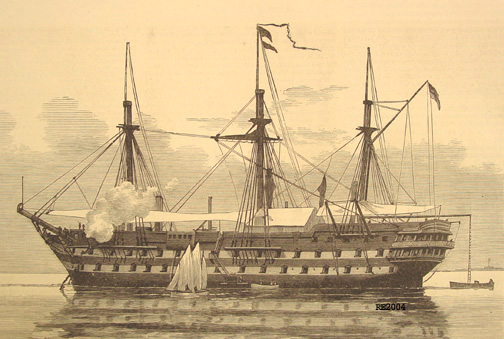
Suppressing slave trade on the East Coast of Africa
1881 drawing, while HMS London was in Zanzibar
HMS London history
Launched in 1840, HMS London was a two decker, wooden ship of the line, converted to screw propulsion in 1858. She had 92 Guns, after conversion 72 Guns. She took part in the bombardment of Fort Constantine at Sevastopol in 1854 during the Crimean War and sustained damage. In 1873 she was placed as a Hulk (depot) ship in the East coast of Africa at Zanzibar bay. In March of 1878 she was commissioned and involved in the suppression of slave trade. Many smaller steam boats were assigned to her for the actual slave boat pursuits and captures. The London was a steam screw boat repair factory, Hospital, and storage ship.
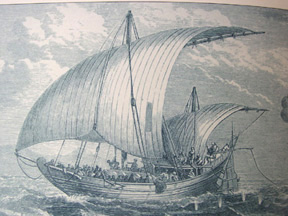
Arab Slavers boat (dhow)
 Slavery was legal in all Muslim countries, and HM ships could only
become involved with slaving when it took place on the high seas.
Slavery was legal in all Muslim countries, and HM ships could only
become involved with slaving when it took place on the high seas.
The boats of HMS London were kept at five minutes notice, ready equipped with water, salt pork, biscuits, arms, local currency and a small cask of rum. Manned by eight or nine sailors, with a midshipman or junior lieutenant in command, a boat was often away from the HMS London for two or three weeks, normally anchoring every night, the men off watch sleeping along the thwarts.
Arab "Dhow" slavers boat. picture from and info: "An illustrated history of the Royal Navy by John Winton, Thunder bay press, 2000"
1880-1882 (my ancestor aboard the HMS London)
The 1881 census shows about 350 individuals on board. The Captain of the HMS London was Capt. Brownrigg, until he and some of his crew were killed by Arab slavers. Our ships log gives him credit for a capture in October 1881. Captain Brownrigg and my ancestor Frank were the only two Royal Navy personnel serving onboard, that were born in India.
Some important information was extracted directly from my Ancestors ship log during the dates of (1.9.80 to 18.9.82) while serving in the Royal Navy aboard the HMS London in Zanzibar. He could have kept this record serving as a clerk, or for his own record of his percent of the prize money. See links page to view the actual ships log!!
Letters written to Frank in Zanzibar from his father James in England during the 1880s.
Franks background:
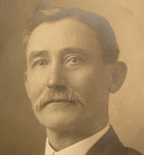
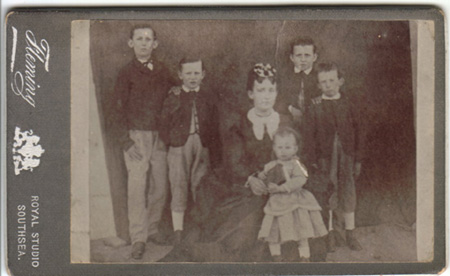
Frank was born in Meerut India (1858). Shown here in 1905 and also in 1872, He was highly educated as a boy, as his father was an Army Schoolmaster. He rode an Elephant to school and lived in a Boat House. He spent 18 years in India before the family moved back to England. There he joined the Royal Navy.
Other Royal Navy Ships that Frank served on:
The vessels that he served on between 1877-1884, included the HMS "St. Vincent, Duke of Wellington, Atalanta, London, Windsor Castle, Excellent."
The captain of the Excellent (Torpedo and Mine training ship) at this time (1884) was "J. A. Fisher" (John Arbuthnot Fisher) who would 20 years later become the top Admiral of the Royal Navy (First Sea Lord). His signature appears in Franks Service Record. Frank left the service, rated as an "AB" Able Seaman.
Some time between September 24th 1879 and January 1880, The HMS Atalanta set sail from England to Bermuda. At this time it was a training ship for young navy personnel. It was reported seen in Bermuda in January, but only stayed a few days. Before this journey, on September 23rd 1879, Frank transferred from the HMS Atalanta to the HMS Duke of Wellington and missed the trip to Bermuda. In January 1880 the Atalanta vanished in the Bermuda triangle, all people lost.
Earlier years of Frank & the family
Family in British India 1857-1878
Franks father James was sent to India in 1857, in response to the Indian Mutiny. He met his wife Georgina soon after the Seige of Lucknow (March 15, 1858). She was in a convent school during this time. Georgina and others put their ears to the ground to hear the Highlanders Bagpipes coming when they were relieved. Her mother was dying and wanted to see her daughter (15yrs old) married. After a while James became an Army Schoolmaster attached to the 85th regiment. They lived in Meerut, Benares, Multan (now pakistan), Allahabad, Rainee tal, Lucknow (Bengal India), as is shown on the childrens birth certificates. Frank was born in December 1859 Meerut India. Meerut was the location where the Indian Mutiny first started.
During the start of the Indian Mutiny of 1857, the HMS Shannon arrived in India first in August and then the HMS Pearl in September. There were so few British troops in India that Pearl's were the only white troops north of the Ganges.
1822 School Book. James book, printed in 1822, given to Frank on July 1880. James must have used this book in India during his Army Schoolmaster years. There is a chance that in the above India picture, the little girl is holding this book.
1854 Leaving England (James joins Navy or Army)
James left Gravesend England in 1854. He may have had Slave Suppression duties along the way to India, as he was shot in the shin by an Arab shortly after this time.
1850's England (James in college)
Before India, James was a choir boy for the Rev. John Keble. (Kebles Hymnals are still being used in many churches around the world to this day.) Keble sent James to school at Winchester college (early 1850s) and then planned to send him to Oxford college. After a few years, he ran away to join the Army and ended up as a Schoolmaster in India.
Related Links and sources of information.
Send your questions or comments to Webmaster
Copyright © 2003 All Rights Reserved
